
Applied AI
AppliedAI in Autologyx brings AI into structured, governed workflows so teams can understand, summarise, extract, and act on information without losing control of the underlying process.
Rather than sitting outside the platform as a standalone tool, AppliedAI is designed to work inside Autologyx Catalyst, where it can support human decision-making, automate repetitive analysis, and help organisations process unstructured content at scale.
AppliedAI now includes several complementary patterns:
- AppliedAI and the Sequencer - where Catalyst workflow automation initiates outbound requests to AI services, orchestrates the work, and uses responses inside a controlled process.
- MCP Work - where approved AI assistants, co-pilots, or autonomous agents use defined tools to work with live Autologyx data and services.
- MCP Success - where approved AI assistants use Autologyx Knowledgebase and Customer Success guidance to help users plan, design, and build effective solutions.
- Security and audit capabilities - where permissions, auditability, and hard-stop access controls wrap around AppliedAI activity.
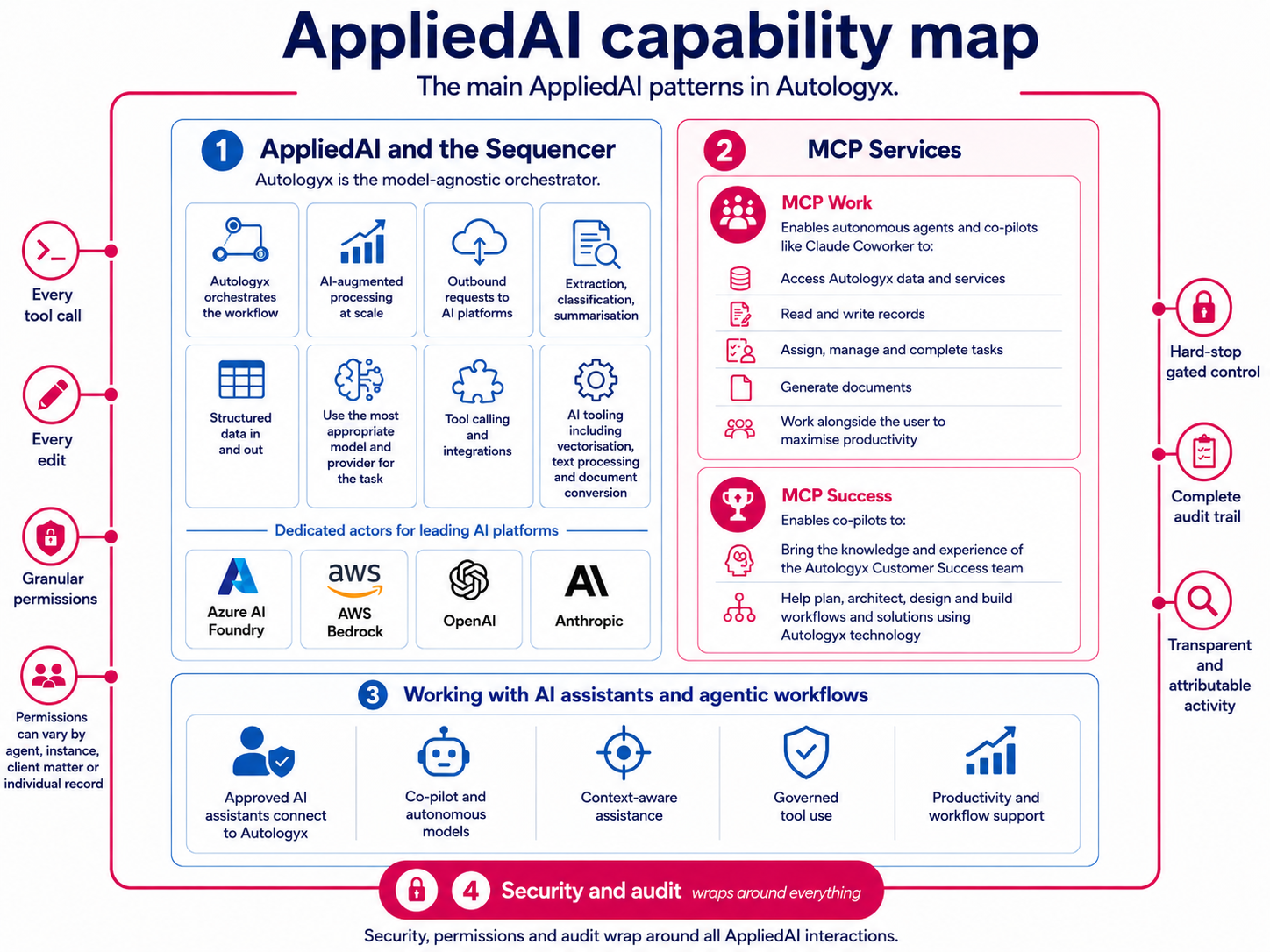
What AppliedAI means in Autologyx
Autologyx combines deterministic workflow automation with AI capabilities that can be used safely, predictably, and at scale.
In practice, that means AI can be used within Sequences, Object records, Task templates, and related workflow steps to help users work faster and more effectively, while still keeping structured business logic, governance, and operational control at the centre of the process.
AppliedAI in Autologyx is designed to support:
- AI inside structured workflows, not outside them
- human-designed processes that are enhanced by AI, not replaced by it
- predictable and auditable outcomes
- model-agnostic implementation, so organisations can use the model that best fits their requirements
- governance, control, and transparency for AI-driven actions
- granular access control for users, co-pilots, autonomous agents, and connected services
AppliedAI and the Sequencer
The Sequencer can be used to send structured requests to AI services, receive responses, and use those responses in later workflow steps.
This pattern is useful where Catalyst should remain the originator and orchestrator of the process. For example, a Sequence might collect record data, prepare a prompt, send it to an AI model, receive a response, store the result on a record, create a task, or route the work based on the response.
With this pattern, Autologyx acts as a model-agnostic orchestrator. Extraction, classification, summarisation, and similar tasks can be handed off as structured data from Autologyx's deterministic workflow to the most appropriate model or provider for the task.
Catalyst can support this pattern through native AI connectivity, dedicated actors, AI tooling, and outbound REST calls using API-based actors.
Examples include:
- sending prompts and record context to OpenAI models
- using Anthropic models where available through a supported integration
- using Azure OpenAI or Azure OpenAI deployments
- using AWS Bedrock to access supported model families
- connecting to privately hosted models or customer-specific AI gateways
- using the API Call actor to call an AI endpoint where there is no native actor
- using vectorisation, text processing, and document conversion to prepare content for AI-assisted processing
- using the Loop Actor and playbook-style Object Classes to run reusable prompt functions across repeated extraction or classification tasks
See AppliedAI and the Sequencer for guidance on using AI services from Catalyst workflow automation.
MCP services
MCP services provide a different AppliedAI pattern.
Instead of Catalyst starting the AI request from a Sequence, MCP allows an approved AI assistant or agent to initiate requests into Autologyx using defined tools. These tools can help the assistant work with Catalyst data, tasks, knowledge, or future configuration capabilities.
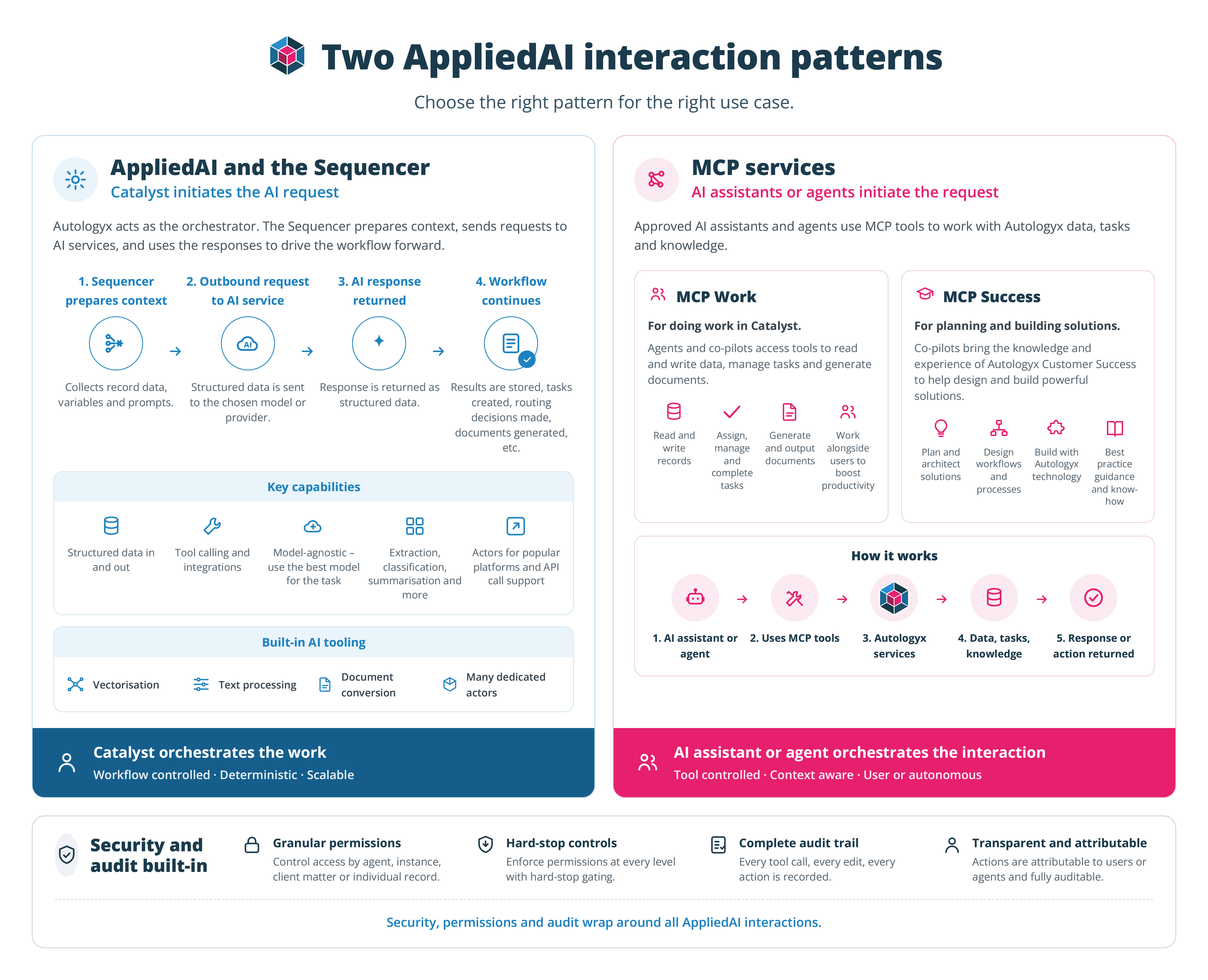
Autologyx MCP services are grouped by purpose:
- Autologyx MCP Work is for working with live Catalyst data and tasks. It supports co-pilot style agents, such as Claude Coworker, working alongside users. It can also support controlled autonomous or headless agents where that model is enabled. MCP Work can help agents access Autologyx data and services, read and write to records, assign, manage and complete tasks, generate documents, and work alongside users to maximise productivity.
- Autologyx MCP Success is for Knowledgebase, design, planning, and configuration guidance. It allows co-pilots to use Autologyx Knowledgebase and Customer Success experience to help Config Admins and configuration users plan, architect, design, and build powerful workflows and solutions using Autologyx technology.
- Autologyx MCP Build is a future capability area for AI-assisted Catalyst configuration, including Object Classes, forms, Task Templates, users, groups, permissions, sequences, and related build components.
See MCP services for more information about the MCP service families.
Working with AI assistants
AppliedAI can also involve direct interaction with AI assistants, such as a desktop AI assistant connected to Catalyst through approved services.
These assistants may help users ask questions, review information, understand tasks, explore records, or get configuration guidance. The exact capability depends on the enabled services, permissions, and customer configuration.
A key distinction is where the interaction starts:
- with AppliedAI and the Sequencer, Autologyx initiates the outbound request and orchestrates the workflow
- with AI assistants and MCP services, the assistant or agent initiates the request into Autologyx through approved tools or APIs
See Working with AI assistants for setup guidance, example prompts, and troubleshooting.
What AppliedAI can help with
AppliedAI capabilities are especially valuable where work is document-heavy, process-driven, and operationally important.
Typical examples include:
- understanding and triaging inbound content
- extracting key data points from documents and messages
- classifying records, requests, documents, clauses, or issues
- summarising long or complex content
- supporting allocation, prioritisation, and workflow routing
- improving speed and consistency in high-volume review processes
- helping teams turn unstructured content into structured, actionable information
- helping users understand records, related records, and tasks
- supporting configuration design, planning, and build decisions
Autologyx describes examples such as email intake, assisted triage and allocation, term extraction, content summarisation, and AI-assisted workflow design as part of its AppliedAI approach.
Why AppliedAI matters
AppliedAI is useful because many operational processes involve large amounts of unstructured information that still need to be handled within a controlled workflow.
By combining AI with deterministic workflow logic, Autologyx helps organisations process work more quickly while still maintaining auditability, predictable handling, and appropriate human oversight. This is particularly important in environments where quality, consistency, and governance matter as much as speed.
AppliedAI is not a replacement for good process design. It is most effective when it is used to support a clear process, with appropriate controls around when AI is used, what information is provided, what action is taken, and when a human should review the result.
Model-agnostic by design
AppliedAI in Autologyx is designed to be model agnostic.
This means organisations can choose the model that best matches their technical, commercial, or governance requirements, and can evolve that choice over time without having to redesign the surrounding workflow. In practical terms, the workflow remains stable while the underlying AI model can change as needs or technologies change.
Different customers may use different AI providers, hosted models, private endpoints, or agent platforms depending on their requirements. AppliedAI documentation explains the patterns that sit around those choices, not only the provider-specific setup.
Built for security, audit, and control
AppliedAI in Autologyx is intended for serious operational use, particularly in environments where trust, governance, and compliance matter.
Security and audit capabilities should wrap around AppliedAI activity. That includes every tool call, every edit, and every action that reads from or writes to live Catalyst data.
AppliedAI governance can include:
- auditability of AI-assisted activity
- human-in-the-loop steps where needed
- guardrails around how AI is used
- deterministic usage policies
- enterprise-grade control and security expectations
- clear separation between read-only guidance and actions that change live data
- controlled access for co-pilot and autonomous agent patterns
- granular permissions that can be changed by agent, instance, client matter, or individual record
- hard-stop gated control over what agents and users can access at every level
See Security, permissions, and governance for guidance on controlling AppliedAI access and activity.
Agentic workflows
Agentic workflows describe patterns where an AI assistant or agent can reason across a goal, choose available tools, and carry out steps within defined boundaries.
In Autologyx, agentic workflows should still be designed around governance, permissions, auditability, and clear process ownership. Some use cases may keep a human in the loop at each important decision point. Others may use autonomous or headless agents for tightly controlled work where the risks and permissions are understood.
See Co-pilot agents and autonomous agents for more information.
What you will find in this section
Use this section to understand the main AppliedAI patterns available in Autologyx and where each one fits.
Browse the sections below:
- AppliedAI and the Sequencer - use AI services from Catalyst workflow automation.
- OpenAI: GPT Actor - configure and use the OpenAI GPT actor in Sequences.
- MCP services - understand Autologyx MCP Work, MCP Success, and future MCP Build capabilities.
- Working with AI assistants - connect and use approved AI assistants with Catalyst.
- Security, permissions, and governance - understand access, permissions, attribution, and control.
- Co-pilot agents and autonomous agents - understand different agent operating models.
Things to remember
- AppliedAI should enhance governed workflows, not bypass them.
- The Sequencer pattern is best where Catalyst should start and control the AI interaction.
- MCP services are best where an approved AI assistant or agent needs to use defined Autologyx tools.
- MCP Work and MCP Success serve different purposes: one works with live data and tasks, while the other supports guidance, planning, and solution design.
- Read-only guidance and live data actions carry different levels of risk and should be governed differently.
- Model choice, prompt design, permissions, and auditability should be considered before AppliedAI is used in production workflows.
INFO
AppliedAI in Autologyx is intended to enhance workflows, not bypass them. The workflow remains the backbone of the process, with AI used where it adds the most value.
TIP
If you are exploring AppliedAI for the first time, start with the pattern that matches your use case: use AppliedAI and the Sequencer where Catalyst should call an AI service from a workflow, or use MCP services where an approved AI assistant or agent should work with Catalyst through defined tools.